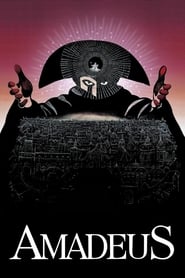
Amadeus (1984)

kroenen

Regimen Morum
6,604
32,491
5.00 star(s) Rating: 5.00/5 4 Votes
Title: Amadeus (1984)

Tagline: Everything you've heard is true...

Genre: History, Music, Drama

Director: Miloš Forman

Cast: F. Murray Abraham, Tom Hulce, Elizabeth Berridge, Simon Callow, Roy Dotrice, Christine Ebersole, Jeffrey Jones, Charles Kay, Kenny Baker, Lisbeth Bartlett, Barbara Bryne, Martin Cavani, Roderick Cook, Milan Demjanenko, Peter DiGesu, Richard Frank, Patrick Hines, Nicholas Kepros, Philip Lenkowsky, Herman Meckler, Jonathan Moore, Cynthia Nixon, Brian Pettifer, Vincent Schiavelli, Douglas Seale, Miroslav Sekera, John Strauss, Karl-Heinz Teuber, Miro Grisa, Samuel Ramey, Helena Cihelníková, Felicity Lott, Karel Gult, Richard Stilwell, Zuzana Kadlecová, Isobel Buchanan, Magda Čelakovská, Anne Howells, Slavěna Drášilová, Deborah Rees, Eva Šenková, Patricia Payne, Leoš Kratochvíl, Alexander Oliver, Gino Zeman, Robin Leggate, Jaroslav Mikulín, John Tomlinson, Ladislav Krečmer, Willard White, Karel Fiala, Richard Stilwell, Jan Blažek, John Tomlinson, Zdeněk Jelen, Willard White, Suzanne Murphy, Suzanne Murphy, June Anderson, Milada Čechalová, Brian Kay, Lisbeth Bartlett, Gillian Fisher, John Carrafa, Sara Clifford, Richard Colton, Shelley Freydont, Anne Glasner, Barbara Hoom, Mary Ann Kellogg, Raymond Kurshals, John Malashock, Jennifer Rawe, Tom Rawe, William Whitener, Hana Brejchová, Miriam Chytilová, Karel Effa, Radka Fidlerová, René Gabzdyl, Karel Hábl, Aťka Janoušková, Marta Jarolímková, Gabriela Krčková, Vladimír Krouský, Jiří Krytinář, Jan Kuželka, Radka Kuchařová, Jiří Lír, Lenka Loubalová, Dagmar Mašková, Ladislav Mikeš, Jitka Molavcová, Jana Musilová, Vojtěch Nalezenec, Pavel Nový, Jiří Opsatko, Jan Pohan, Tereza Pokorná-Herzová, Ivan Pokorný, Milan Riehs, Iva Šebková, Zdeněk Sklenář, Renata Vacková, Jiří Vančura, Dana Vávrová, Petra Vogelová, Josef Zeman, Viktor Maurer, Zdeněk Mahler, Vladimír Svitáček, Karel Engel, Antonín Kramerius, Zbyněk Bruthans, Lubomír Havlák

Release: 1984-09-19

Runtime: 160

Plot: Disciplined Italian composer Antonio Salieri becomes consumed by jealousy and resentment towards the hedonistic and remarkably talented young Viennese composer Wolfgang Amadeus Mozart.
 

kroenen

Regimen Morum
6,604
32,491


  • Video: 2160p resolution (4K) with HDR10, remastered from the original film.
  • Audio: English DTS-HD Master Audio 5.0, along with Dolby TrueHD 5.1 and Dolby Digital 5.1.
  • Special Features:
    • 4K restoration of the theatrical cut.
    • "The Making of Amadeus" featurette.
    • "The Making of Amadeus" documentary.
    • U.S. Release Date: February 25, 2025.

This is the rare original theatrical cut, remastered in 4K. It was last available on DVD in the 90s. Since 2002, only the Director's Cut has been released, but some fans still prefer the original for its tighter and more focused story. Amadeus was originally mixed in a 5.0 channel format for its sound design, preserved in the remastering process (DTS Master Audio track) to maintain the original experience.

Zaentz was one of the first people to bring their collection to the Film Archive when it opened in 1991. “The way he produced his films in a unique kind of way for the time period he was active,” said archive director Mike Pogorzelski in a recent Zoom chat. “He would only make deals for distribution with studios. The Saul Zaentz Company owned all the movies; the studios did not. When the film was released on DVD, Saul wanted to create a new version of it that was marketed as ‘Amadeus (Director’s Cut).’ He wanted to access the original negative to make that version. So, the negative was cut. For all of those years, since 2001, the original camera negative has only existed in this alternate version.”

The producer died at the age of 92 in 2014; his nephew Paul Zaentz now owns the company. He has always preferred the original two-hour 40-minute version over the three-hour eight-minute director’s cut. “So, we all came together in a way we all want to: Paul, because he wants to put ‘Amadeus’ back into distribution for the 40th anniversary of its release and for us, the academy we want the version that the academy members awarded,” noted Pogorzelski.

Because nothing had been taken out of the negative, it made the Academy Film Archive’s job a little easier. “We weren’t trying to find missing footage for the most part,” said archive preservationist Tessa Idlewine. “It just meant we lost a frame on either side on the original negative. It meant replacing those two frames. We used a 35mm interpositive…we were able to fill those in.” Luckily, she added, the original negative was in “pretty good shape” with some dirt, and scratches.”

 
  • 1Like
  • 1Horowitz
Reactions: 1 users

Gask

Aten Ha Ra Slayer
14,975
61,994
A very good movie but the portrayal of Antonio Salieri as this scheming malevolent antagonist is something that was concocted out of thin air. It works fantastically for the film but none of that actually happened.
 
  • 3Like
Reactions: 2 users

Adebisi

Clump of Cells
<Silver Donator>
28,227
31,151
Saw the restored version in theatres yesterday. This is personally my favorite movie of all time.

I agree that the director's cut is not great. Theatrical for life
 
  • 2Like
Reactions: 1 users

Nabi

<Aristocrat╭ರ_•́>
528
1,750
As someone that watched this movie for the first time on WGN over two days, TV edit when? I always thought it was robert downey jr that played Amadeus, and TIL the Amadeus song is real and not something made up for the Simpsons.
edit: just looked it up and the Simpsons version is Dr. Zaius, not Amadeus. Melodies sound same... WTF did my mind just substitute the names?
 

TheNozz

Bronze Baron of the Realm
9,355
48,353
I remember seeing the directors cut and being surprised they showed breasts in it.

regardless, no matter which version, this is an excellent film
 
  • 1Like
Reactions: 1 user

kroenen

Regimen Morum
6,604
32,491
UK based Sky TV is taking a stab at this with its own TV show. A half Japanese actor stars as Amadeus, joined by a mix of Indian actors and the obligatory DEI quota of African cast members. 18th century Austria, truly the multicultural melting pot according to Sky TV.

 
  • 2Worf
  • 2WTF
  • 1Garbage
Reactions: 5 users

Adebisi

Clump of Cells
<Silver Donator>
28,227
31,151
Not really into what the director has done and I'm only somewhat familiar with what the screenwriter has done.

Decent chance this will blow
 

kroenen

Regimen Morum
6,604
32,491

tumblr_nkrr916ITp1tdy0nco1_500.gif
 
  • 1Barf
Reactions: 1 user

Runnen

Ahn'Qiraj Raider
2,222
5,574
Not really into what the director has done and I'm only somewhat familiar with what the screenwriter has done.

Decent chance this will blow

At least if this ends up being a huge pile of shit, you know Mozart would have loved it.
 

kroenen

Regimen Morum
6,604
32,491
All 5 episodes out on Sky UK and HBO Max in select EU countries and torrents.

18th-century Vienna has never looked more like a diverse New York subway station than in this Sky adaptation.


TELEMMGLPICT000453780428_17660540595830_trans_NvBQzQNjv4BqvcqThnSUDc9UMlRYzyV5_GGz6Y2iXDFGR-ZR...jpg
2535.jpg
 
  • 1Barf
  • 1Worf
  • 1Salty
Reactions: 2 users

The Morrigan

Potato del Grande
115
-21
All 5 episodes out on Sky UK and HBO Max in select EU countries and torrents.

18th-century Vienna has never looked more like a diverse New York subway station than in this Sky adaptation.


View attachment 613602View attachment 613603
This is such a tired complaint. People don't know their own history.

Was diversity in Victorian England and Ancient Greece impossible?


Short answer: No. Both societies were more diverse than modern stereotypes imply. The idea that everyone in these eras was uniformly light‑skinned is a myth, not a historical reality.


Below is a structured look at each period, grounded in the search results you triggered.


🕰️ Victorian England (1837–1901)


🌐 Britain was the center of a global empire


Victorian Britain ruled over territories across Africa, the Caribbean, India, the Middle East, and the Pacific. This meant constant movement of people into and out of the British Isles.


  • London in the early 19th century already had significant immigrant populations, including Germans, Jews, Africans, South Asians, and others.
  • Interracial relationships and “racial crossings” were a documented Victorian concern — precisely because they were happening.

🧭 Real examples of diversity in Victorian England


  • Black sailors, servants, and professionals lived in port cities like London, Liverpool, and Cardiff.
  • South Asian lascars (sailors) were common in British ports.
  • Mixed‑race communities existed in London and elsewhere.
  • The Victorian press wrote about people from Africa, the Caribbean, and Asia living in Britain.

🧩 Why people assume otherwise


Victorian art, photography, and literature often centered the white British middle class — which creates a false monocultural image. But historians emphasize that Victorian society was not homogenous and that diversity was part of everyday life.
 
  • 1Garbage
  • 1Pathetic
  • 1Seriously?
Reactions: 3 users

Aldarion

Egg Nazi
11,199
30,644
In the old days parachuters at least wrote their own poorly thought out complaints.

In 2025 we get parachuters with AI slop.

Everything gets faker and gayer every day
 
  • 4Like
Reactions: 3 users

TomServo

<Bronze Donator>
8,505
14,943
This is such a tired complaint. People don't know their own history.

Was diversity in Victorian England and Ancient Greece impossible?


Short answer: No. Both societies were more diverse than modern stereotypes imply. The idea that everyone in these eras was uniformly light‑skinned is a myth, not a historical reality.


Below is a structured look at each period, grounded in the search results you triggered.


🕰️ Victorian England (1837–1901)


🌐 Britain was the center of a global empire


Victorian Britain ruled over territories across Africa, the Caribbean, India, the Middle East, and the Pacific. This meant constant movement of people into and out of the British Isles.


  • London in the early 19th century already had significant immigrant populations, including Germans, Jews, Africans, South Asians, and others.
  • Interracial relationships and “racial crossings” were a documented Victorian concern — precisely because they were happening.

🧭 Real examples of diversity in Victorian England


  • Black sailors, servants, and professionals lived in port cities like London, Liverpool, and Cardiff.
  • South Asian lascars (sailors) were common in British ports.
  • Mixed‑race communities existed in London and elsewhere.
  • The Victorian press wrote about people from Africa, the Caribbean, and Asia living in Britain.

🧩 Why people assume otherwise


Victorian art, photography, and literature often centered the white British middle class — which creates a false monocultural image. But historians emphasize that Victorian society was not homogenous and that diversity was part of everyday life.
Good job retard. I rate this chatgpt model 4.2. Faggot edition
 
  • 2Worf
Reactions: 1 users

Burns

Avatar of War Slayer
8,796
16,966
This is such a tired complaint. People don't know their own history.

Was diversity in Victorian England and Ancient Greece impossible?


Short answer: No. Both societies were more diverse than modern stereotypes imply. The idea that everyone in these eras was uniformly light‑skinned is a myth, not a historical reality.


Below is a structured look at each period, grounded in the search results you triggered.


🕰️ Victorian England (1837–1901)


🌐 Britain was the center of a global empire


Victorian Britain ruled over territories across Africa, the Caribbean, India, the Middle East, and the Pacific. This meant constant movement of people into and out of the British Isles.


  • London in the early 19th century already had significant immigrant populations, including Germans, Jews, Africans, South Asians, and others.
  • Interracial relationships and “racial crossings” were a documented Victorian concern — precisely because they were happening.

🧭 Real examples of diversity in Victorian England


  • Black sailors, servants, and professionals lived in port cities like London, Liverpool, and Cardiff.
  • South Asian lascars (sailors) were common in British ports.
  • Mixed‑race communities existed in London and elsewhere.
  • The Victorian press wrote about people from Africa, the Caribbean, and Asia living in Britain.

🧩 Why people assume otherwise


Victorian art, photography, and literature often centered the white British middle class — which creates a false monocultural image. But historians emphasize that Victorian society was not homogenous and that diversity was part of everyday life.
It's ironic that this is used to justify inserting racial diversity where there was none and in turn white washing the struggles that the actual minorities went through in Europe during that time.

As the AI listed, they were the underclass that everyone would have shit on; none of them would have been attending high society entertainment as guests. Some of the ruling class may have kept them as servants, like some exotic pet, but they would have been whipped for insolence if they stopped and gawked like they were enjoying themselves, instead of standing at attention or going about their business. At best, in Vienna, among high society there may have been Greek, Slavic, and Turkish looking people, as the Austro-Hungarian Empire held part of the Balkans and most of southeastern Europe.

Indians in particular were in vogue as manservants in England for a time, but don't think for a second that they weren't second third class citizens everywhere they went.
 
Last edited:
  • 3Like
Reactions: 2 users

kroenen

Regimen Morum
6,604
32,491
This is such a tired complaint. People don't know their own history.

My original post was about Vienna during Mozart’s active years at the Habsburg court, not Victorian England a century later. Yes, Black individuals existed in early modern Europe, including Vienna, but almost exclusively in marginal or symbolic roles: servants or exotic curiosities etc.
The Habsburg court was rigidly hereditary, Catholic, and genealogical. There is no historical evidence of Black nobles, palace guards, or integrated court elites with German dynastic names in Mozart’s Vienna.

Victorian dockside diversity doesn’t retroactively rewrite Habsburg court genealogy.
 
  • 2Like
Reactions: 1 users
Movie information in first post provided by The Movie Database