
The Astronomy Thread

Aaron

Goonsquad Officer
<Silver Donator>
10,172
25,711
Did anyone see Halley's comet in 1986? I was 9 years old and I remember my dad going out early in the morning to try to see it through his rifle scope but I don't think he ever did. You couldn't get as much good advice about when and where to look as you can now. I'll be 84 next time it comes around if I make it that long. I am lucky enough to live in a great place to look at stars.
I was a boy living in the UK then. Glad my parents took my out one clear night with some binoculars to see it. I remember the trail well. I also remember trying to figure out how old I'd be when I saw it next and realising I'd be "old as hell".

If I had children, I would try to get them to see these things even if it meant a short trip as it often is a once in a lifetime experience, and at least if they aren't dumbasses, it will leave an impression.
 
  • 2Like
Reactions: 1 users

BrutulTM

Good, bad, I'm the guy with the gun.
<Silver Donator>
15,512
-296
1000012232.jpg

Just saw this over SW North Dakota. I thought it must be a starlink train but it looks like they haven't launched since Monday. Anyone know what it could be or should I be posting in the paranormal thread?
 
  • 1WTF
Reactions: 1 user

Pharazon2

Trakanon Raider
778
1,416
Download Stellarium free to your phone and point. It'll tell you if they are starlink or other satellites I think. I know for sure it shows Starlinks, just don't know if it has them all catalogued or how long after they launch.
 
  • 1Like
  • 1Truth!
Reactions: 1 users

Burns

Avatar of War Slayer
8,762
16,900
View attachment 609063
Just saw this over SW North Dakota. I thought it must be a starlink train but it looks like they haven't launched since Monday. Anyone know what it could be or should I be posting in the paranormal thread?
Could be China's Spacesail network that they are launching to compete with Starlink (or to try to force their internet rules on more people).

 
  • 2Like
Reactions: 1 users

Aldarion

Egg Nazi
11,155
30,499


It didnt break up, its still a single body with a jet pointing toward the sun

This raises a new anomaly of 3I/ATLAS that must be explained by those who wish to shove the anomalies of 3I/ATLAS under the carpet of traditional knowledge on solar system comets rather than consider alternatives. As Albert Einstein said: “Knowledge is realizing that the street is one way; wisdom is looking in both directions anyway.”

Technological thrusters which point their exhaust towards the Sun would accelerate away from the Sun. This post-perihelion maneuver might be employed by a spacecraft that aims to gain speed rather than slow down through the gravitational assist from the Sun.
 
  • 1Like
Reactions: 1 user

MusicForFish

Ultra Maga Instinct
<Prior Amod>
40,306
158,739
View attachment 609063
Just saw this over SW North Dakota. I thought it must be a starlink train but it looks like they haven't launched since Monday. Anyone know what it could be or should I be posting in the paranormal thread?
That really does look like a Starlink train. They usually disperse into the grid shortly after launch... Maybe another company or country with an unannounced sat grid? Interesting at least.
 
  • 1Like
Reactions: 1 user

Kiroy

Marine Biologist
<Bronze Donator>
36,282
106,524


It didnt break up, its still a single body with a jet pointing toward the sun


apparently it lost like 15% of it's mass which shouldn't really be possible, with it's size, while staying together.
 
  • 3Like
Reactions: 2 users

Kharzette

Watcher of Overs
5,952
5,952
Is the solar stuff still going? My wireless inet has been shiite the past few days and wondering if I should blame it on that.
 

meStevo

I think your wife's a bigfoot gus.
<Silver Donator>
6,786
5,133
Manley goes through all the stuff NASA released.


A gemini recap by instrument:

The video details the findings about interstellar comet 3I/ATLAS from various instruments, both ground-based and space-based, as it passed through the solar system.
Here is a summary of the findings by instrument:


Ground-Based and Orbital Telescopes (Early Observations)​


  • Gemini South and NASA's Infrared Telescope Facility
    • Found evidence for water ice in the cloud surrounding the nucleus 02:15 Opens in a new window . This was considered a not-surprising and expected finding.
  • Hubble Space Telescope (HST)
  • James Webb Space Telescope (JWST)
    • Performed infrared spectroscopy and identified signatures of water and carbon dioxide 03:31 Opens in a new window .
    • Discovered that the comet was emitting significantly more carbon dioxide than water, with an estimated ratio of 8:1 03:36 Opens in a new window . This high ratio is extremely rare for comets.
    • The comet appeared to be carbon chain depleted, meaning it has much simpler carbon molecules (not larger carbon molecules) 05:02 Opens in a new window .
  • Sphere X
  • Very Large Telescope (VLT) - Near Ultraviolet Observation
    • Found a surprisingly large amount of nickel using spectroscopy, which is unusual as nickel processes typically also form iron 05:21 Opens in a new window .
    • Later observations, as the comet came closer, started to show more iron, making the numbers consistent with the likely process of volatile nickel carbonyls evaporating and then producing the nickel seen 05:43 Opens in a new window .


Spacecraft Around Mars (Close Approach)​


Solar and Deep Space Missions​


  • SOHO (Solar and Heliospheric Observatory)
    • Detected the comet on the opposite side of the sun by stacking multiple images to bring out the comet's image against the background 10:36 Opens in a new window .
  • Punch Spacecraft (Polarimeter for Unifying the Corona and Heliosphere)
  • STEREO Spacecraft
  • Psyche Mission
  • Lucy Mission (Long Range Reconnaissance Imager)
 
  • 7Like
Reactions: 6 users

Pharazon2

Trakanon Raider
778
1,416
So we know 3I/Atlas showed non-gravitational acceleration at perihelion, much larger acceleration than any previous comet at that distance, but the course change overall was still piddling. However, new evaluation shows the course change was just enough so that the object will be on the edge of Jupiter's "hill radius" when it passes by. The hill radius is the point that delineates where gravity transitions from Jupiter dominated to sun dominated. Inside the hill radius, Jupiter gravity supercedes the sun's; outside the hill radius, the sun's gravity dominates again.

So without the non-gravitational acceleration, 3I / Atlas would have been outside Jupiter's hill radius. After the non-gravitational acceleration, it is now almost perfectly on course to pass at the edge of Jupiter's hill radius, making it ideal to potentially launch probes to orbit Jupiter. Just another coincidence with super super small likelihood? Probably...


Another interesting thing is they've been noticing these "jets" in a lot of the recent images. Some speculation now that one of the jets is not pointing away from sun or towards sun as would be expected, but in the direction of motion. Angry Astronaut mentions that in the video above (and quickly jumps to far out speculation on what it could be), but you can kind of see it the video below at times. This amateur astrophotographer had one of his images showing a huge tail going around recently. He does a lot of post-processing, and seems surprised at how weird it looks after all of it, but i'd be curious as to what a normal comet would look like through the same post-processing. He still calls it a comet - at about 13:30 in the video as he's changing the brightness he's like "oh god... there's that shape, i don't understand that.. like a jet on both sides kind of." It almost looks like a cone in some shots in the direction of travel, but could be an optical illusion due to the angle of capture. Interesting anyways.

 
  • 3Like
Reactions: 2 users

Burns

Avatar of War Slayer
8,762
16,900
Easy to digest overview of three of the largest issues/problems currently being discussed in Astrophysics:

 
  • 3Like
Reactions: 2 users

Araxen

Golden Baronet of the Realm
10,931
8,372
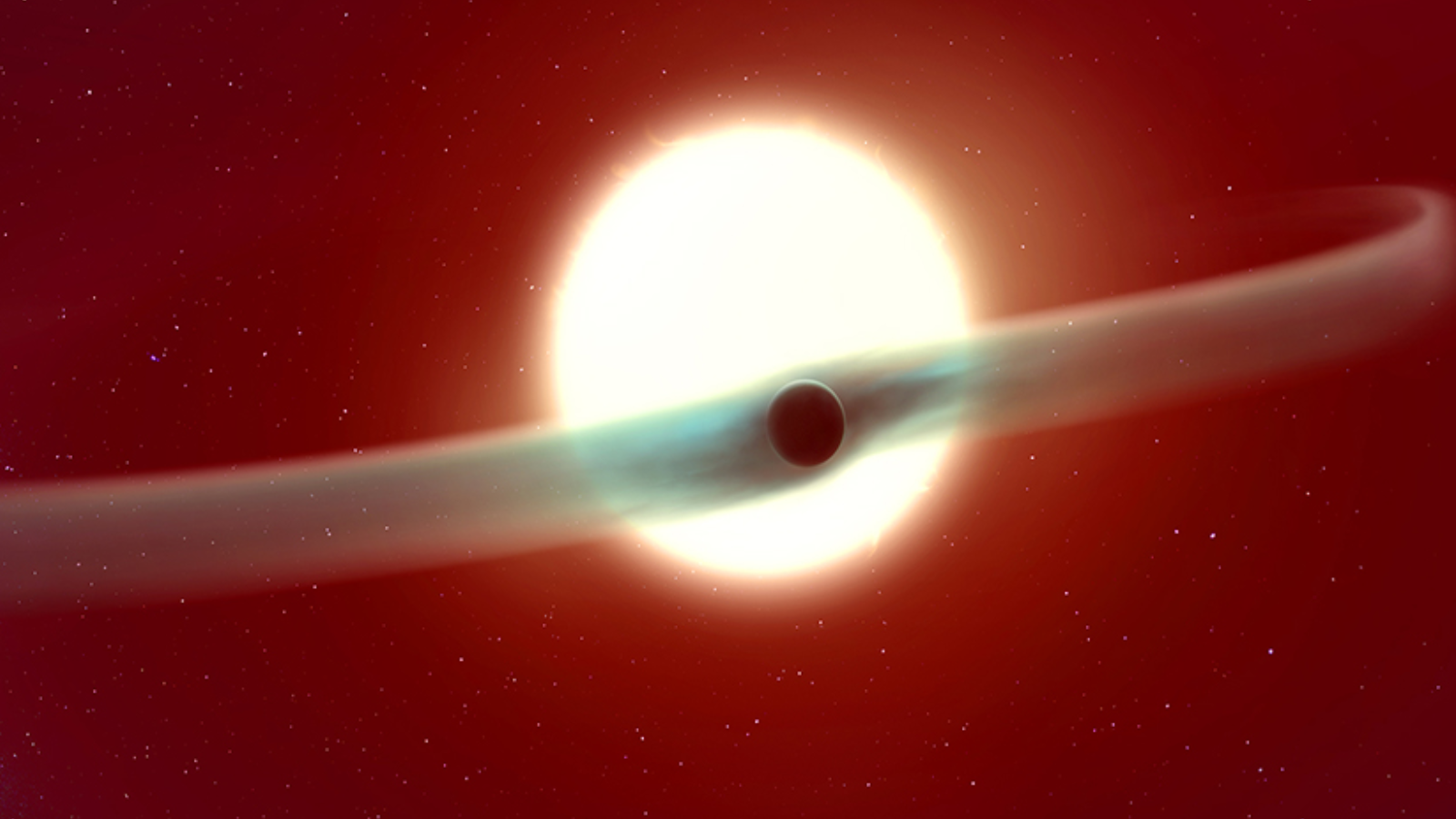
Astronomers have used the James Webb Space Telescope (JWST) to discover that a distant "hot Jupiter" planet has two staggeringly long tails composed of helium that currently defy explanation. The observations represent the first study of gases leaking from a planet beyond the solar system during one of its complete orbits, and help paint the most complete picture of atmospheric escape thus far.

The extrasolar planet, or exoplanet, in question is WASP-121b, also known as "Tylos," located around 858 light-years away. WASP-121b is an example of an "ultrahot Jupiter," a massive gas giant planet found so close to its parent star that it can complete an orbit in a matter of hours. As WASP-121b whips around its star once every 30 hours, intense radiation from its stellar parent heats its atmosphere to around 4,200 degrees Fahrenheit (2,300 degrees Celsius).

When a planet undergoes this type of heating, it causes gases of lighter elements like hydrogen and helium to flow into space, a slow atmospheric escape lasting millions of years that alters the planet's size, composition, and how it will evolve. Previously, scientists had caught glimpses of atmospheric escape as exoplanets passed in front of their parent stars, an event called a "transit." But this left a gap in our understanding of this process because scientists couldn't be sure if planetary atmospheres continued to leak outside of those few hours when the planets were observed during a transit.

 
  • 3Like
Reactions: 2 users